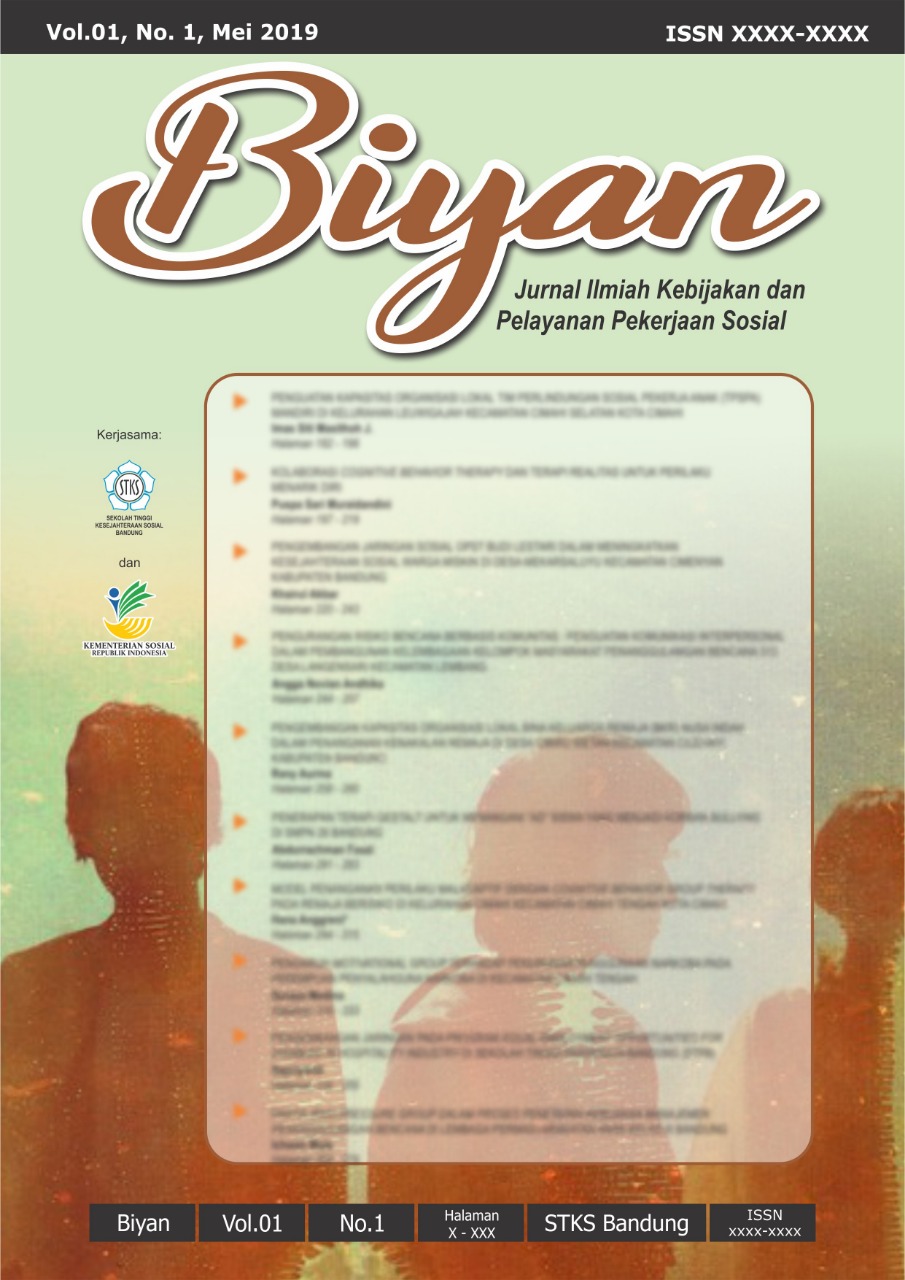
The Participatory Team Workplan Technology in the Work Program Development at LKSA Sidhi Astu Bali.
DOI:
https://doi.org/10.31595/biyan.v6i2.1363Keywords:
participation, workplan, orhpanageAbstract
Participation refers to an individual's active involvement in a particular activity, where their role is not passive but actively directed toward the implementation of the activity. At LKSA Sidhi Astu Bali, work programs have traditionally been prepared individually by the headmaster, with minimal active participation from employees. To address this gap, this research investigates the implementation of a team building participatory work plan model in the preparation of work programs at LKSA Sidhi Astu Bali. The aim of the research is to develop and enhance the previous work plan model. This study employs a qualitative approach using the Participatory Action Research (PAR) method. Data collection was conducted through in-depth interviews, documentation studies, participant observation, and focus group discussions. The data were analyzed using qualitative data analysis techniques. The results of the research indicate that the team building participatory work plan model has a positive impact on the preparation of work programs at LKSA. The final model incorporates stages that involve children in the work program preparation process, ensuring that the resulting work program prioritizes the common good, particularly the best interests and well-being of the children.
References
Argyris, C., & Schön, D. A. (1978). Organizational Learning: A Theory of Action Perspective. Addison-Wesley.
Arnstein, S. R. (1969). A Ladder of Citizen Participation. Journal of the American Institute of Planners, 35(4), 216-224. https://doi.org/10.1080/01944366908977225.
Bakker, A. B. (2009). Building engagement in the workplace. HRD Press.
Bronfenbrenner, U. (1979). The Ecology Of Human Development: Experiments By Nature And Design. Harvard University Press.
Cohen, J. M., & Uphoff, N. T. (1980). Participation's Place in Rural Development: Seeking Clarity through Specificity. World Development, 8(3), 213-235. https://doi.org/10.1016/0305-750X(80)90011-X,
Chevalier, J. M., & Buckles, D. J. (2013). Participatory Action Research: Theory and Methods for Engaged Inquiry. Routledge. https://doi.org/10.4324/9780203107386
Hackman, J. R. (2002). Leading teams: Setting the stage for great performances. Harvard Business School Press.
Harvard Business Review. (2011). "The Effective Executive: The Definitive Guide to Getting the Right Things Done."
Hidayat, N., & Muliadi, M. (2015). "Validitas dan Reliabilitas Data dalam Penelitian Kualitatif: Teknik Triangulasi dan Member Checking." Jurnal Penelitian Pendidikan, 15(2), 88-97..
Hirschman, A. O. (1970). Exit, Voice, and Loyalty: Responses to Decline in Firms, Organizations, and States. Harvard University Press.
Huszczo, G. E. (1999). Tools for team excellence. Davies-Black Publishing.
Klein, C., DiazGranados, D., Salas, E., Le, H., Burke, C. S., Lyons, R., & Goodwin, G. F. (2009). "Does Team Building Work?" Small Group Research, 40(2), 181-222. https://doi.org/10.1177/1046496408328821
Lansdown, G. (2019). Conceptual Framework for Measuring Outcomes of Adolescent Participation. UNICEF. https://doi.org/10.18356/54a0c72b-en
Mardikanto, T. (1994). Pembangunan Partisipatif. Gadjah Mada University Press.
Mayer, I. S., Van Daalen, C. E., & Bots, P. W. G. (2004). Perspectives on policy analysis: A framework for understanding and design. International Journal of Technology, Policy and Management, 4(2), 107-122.
Rahman, M. S. (2016). "The Advantages and Disadvantages of Using Qualitative and Quantitative Approaches and Methods in Language 'Testing and Assessment' Research: A Literature Review." Journal of Education and Learning, 6(1), 102-112. https://doi.org/10.5539/jel.v6n1p102
Rich, B. L., Lepine, J. A., & Crawford, E. R. (2010). Job engagement: Antecedents and effects on job performance. Academy of Management Journal, 53(3), 617-635. https://doi.org/10.5465/amj.2010.51468988
Salas, E., Shuffler, M. L., Thayer, A. L., Bedwell, W. L., & Lazzara, E. H. (2015). "Understanding and Improving Teamwork in Organizations: A Scientifically Based Practical Guide." Human Resource Management, 54(4), 599-622. https://doi.org/10.1002/hrm.21628
Sarifudin, S. (2020). Kepuasan Kerja dan Partisipasi Karyawan dalam Organisasi. Jurnal Manajemen Organisasi, 6(1), 123-135. https://doi.org/10.24843/jmo.2020.01
Tourish, D. (2010). "Auditing Organizational Communication: A Handbook of Research, Theory, and Practice." International Journal of Business Communication, 47(4), 465-467. https://doi.org/10.1177/0021943610377303
Vecina, M. L., Chacón, F., Sueiro, M., & Barrón, A. (2012). Volunteer engagement: Does engagement predict the degree of satisfaction among new volunteers and the commitment of those who have been active longer?. Applied Psychology, 61(1), 130-148. https://doi.org/10.1111/j.1464-0597.2011.00460.x
Downloads
Published
How to Cite
Issue
Section
Citation Check
License
Copyright (c) 2026 Christopher Damian Unisi Naibaho, Susilawati Susilawati, Moch Zaenal Hakim

This work is licensed under a Creative Commons Attribution-NonCommercial-ShareAlike 4.0 International License.
Policy for Journals that offer open acces
Authors who publish with this journal agree to the following terms:
- Authors retain copyright and grant the journal right of first publication with the work simultaneously licensed under a Creative Commons Attribution-NonCommercial-ShareAlike 4.0 International License that allows others to share the work with an acknowledgement of the work's authorship and initial publication in this journal.
- Authors are able to enter into separate, additional contractual arrangements for the non-exclusive distribution of the journal's published version of the work (e.g., post it to an institutional repository or publish it in a book), with an acknowledgement of its initial publication in this journal.
- Authors are permitted and encouraged to post their work online (e.g., in institutional repositories or on their website) prior to and during the submission process, as it can lead to productive exchanges, as well as earlier and greater citation of published work (See The Effect of Open Access).